
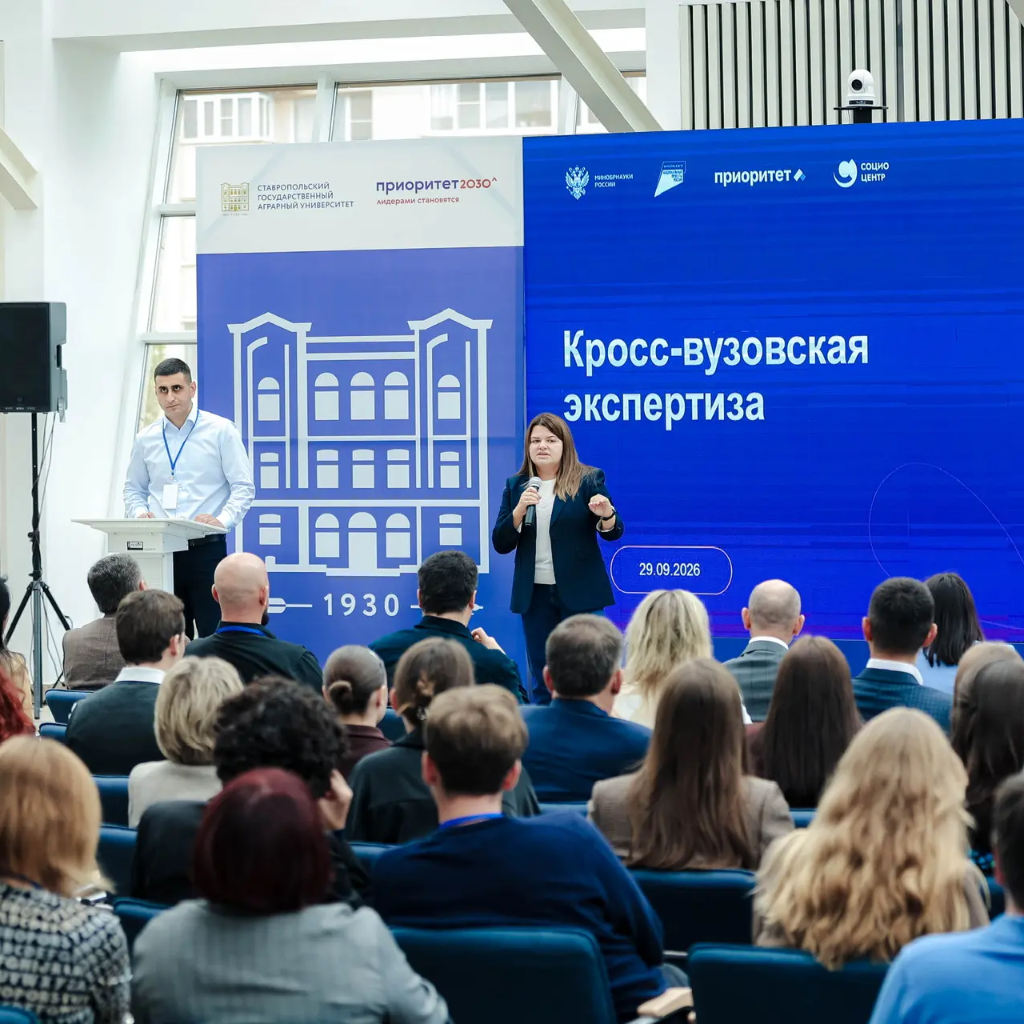
The two‑day project and analytical session within the framework of the cross‑institutional review of the «Priority‑2030» programme has concluded at Stavropol State Agrarian University. Experts from the country’s leading scientific and educational organisations, together with Ksenia Shevelkina, Deputy Minister of Agriculture of the Russian Federation, carried out a comprehensive analysis of the university’s work and prepared proposals to strengthen the target model of its development.
The cross‑institutional review gave StSAU an opportunity to assess the chosen course from the outside, record the results achieved, identify growth points and clarify specific areas for further work. The university’s main strategic goal remains unchanged — to strengthen its position among Russia’s leading institutions in education, research, and development in key areas of scientific and technological development for the agro‑industrial complex.
The work was carried out in five specialized groups. Experts analysed the university’s educational and research policy, its human capital management system, digitalisation, biologisation, breeding and genetics, as well as the implementation of strategic projects. This format made it possible to examine in detail the key areas of transformation of StSAU and compare them with the current challenges of high‑tech agribusiness.
During the session, experts examined the university’s achievements through the lens of Russian and international experience. Among the proposed areas for further development are the creation of consortia with research institutes and agricultural enterprises, the establishment of an International EAEU Center on the basis of Stavropol State Agrarian University, and the introduction of an unmanned field production ecosystem.
Special attention was paid to how the university can strengthen the link between science, education, and the real sector of the economy. In today’s conditions, the agro‑industrial complex needs solutions in the areas of digitalization, breeding, genetics, biotechnology, unmanned systems, data management, and training of personnel at a new level. It is precisely these areas that Stavropol State Agrarian University is focusing on in its strategic agenda.
The expertise also made it possible to assess the interim results of the university team within the framework of the «Priority‑2030» programme. An independent perspective from external experts helps not only to confirm the effectiveness of the solutions that have already been chosen but also to more precisely adjust the mechanisms for developing educational, scientific, personnel, and innovation policies.
For us, cross‑institutional expertise is an opportunity to verify the chosen course and more precisely adjust the target model for the university’s further development. Our strategic goal remains unchanged — to secure a position as one of Russia’s leading institutions in education, research, and development in key areas of scientific and technological development for the agro‑industrial complex. I thank the experts for their independent perspective and high assessment of our team’s interim results, and I thank the university staff for their dedication and involvement at all stages of the work. «I am confident that it is precisely through such an open dialogue that solutions are born that can qualitatively transform science, education, and personnel policy to meet the real challenges of high‑tech agricultural business, ” said Vladimir Sitnikov, Rector of Stavropol State Agrarian University.
Stavropol State Agrarian University will continue to implement the Priority‑2030 programme, developing strategic projects, partnerships with scientific and industrial organisations, digital solutions, breeding and genetic research, and next‑generation educational programmes. The results of the cross‑institutional assessment will form the basis for further strengthening the position of Stavropol State Agrarian University as one of the leading centres for training personnel, conducting research, and developing technologies for the domestic agro‑industrial complex.